
Fall 2024
This class, taught by Terry Pieritz, was a survey course that covered wide range of topics, beginning with the responsibilities of a costume designer and ending with designing for film/television vs. live theatre. We discussed fabrics, color and texture, silhouette, and what these things can communicate about a setting and the characters in it.
Object Design Rendering
Our very first project was to choose an item, and draw a design rendering inspired by it, focusing on capturing the essential features and overall silhouette of the object. I chose a glass bottle that belonged to my grandmother before she passed away.
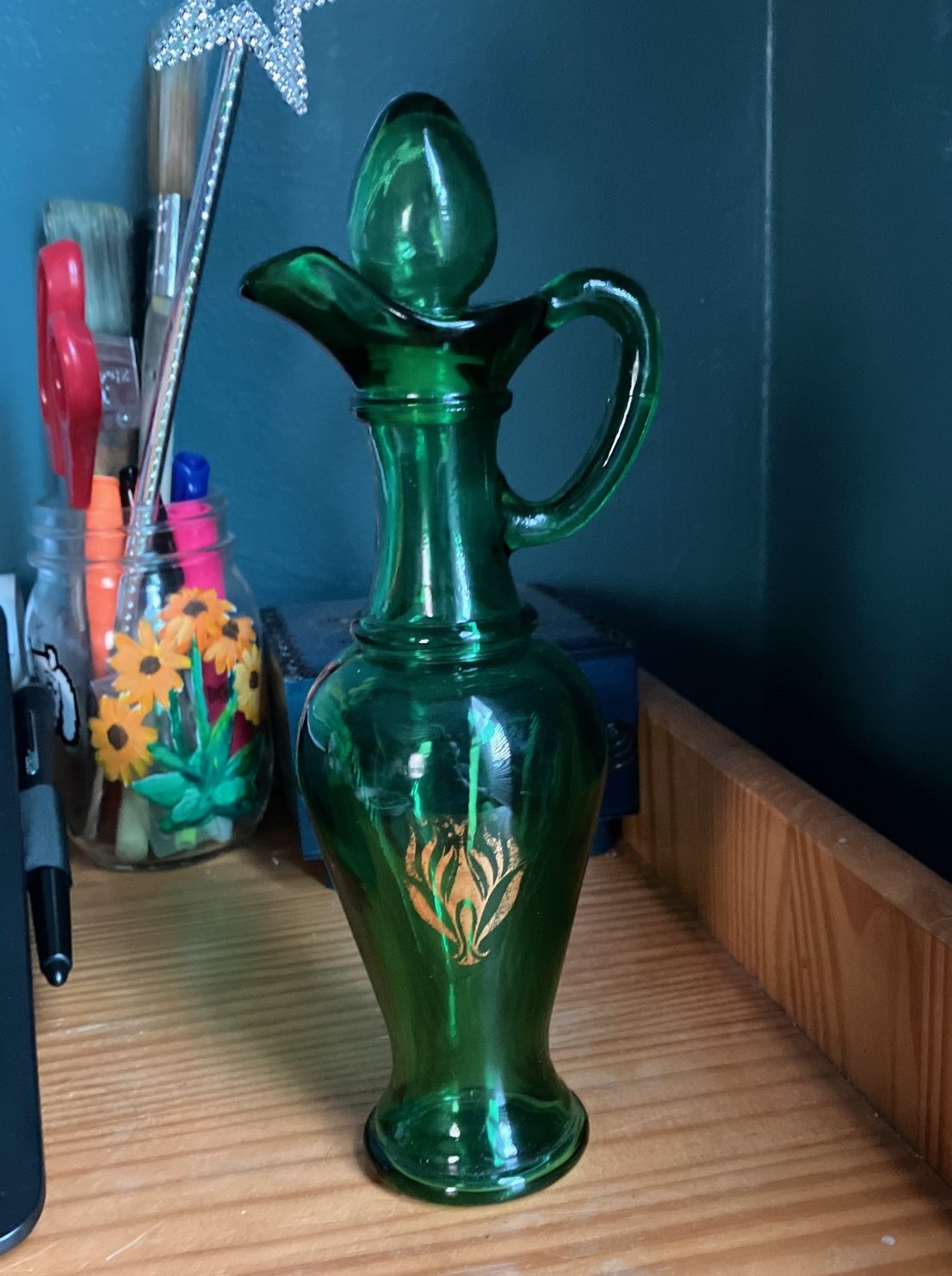
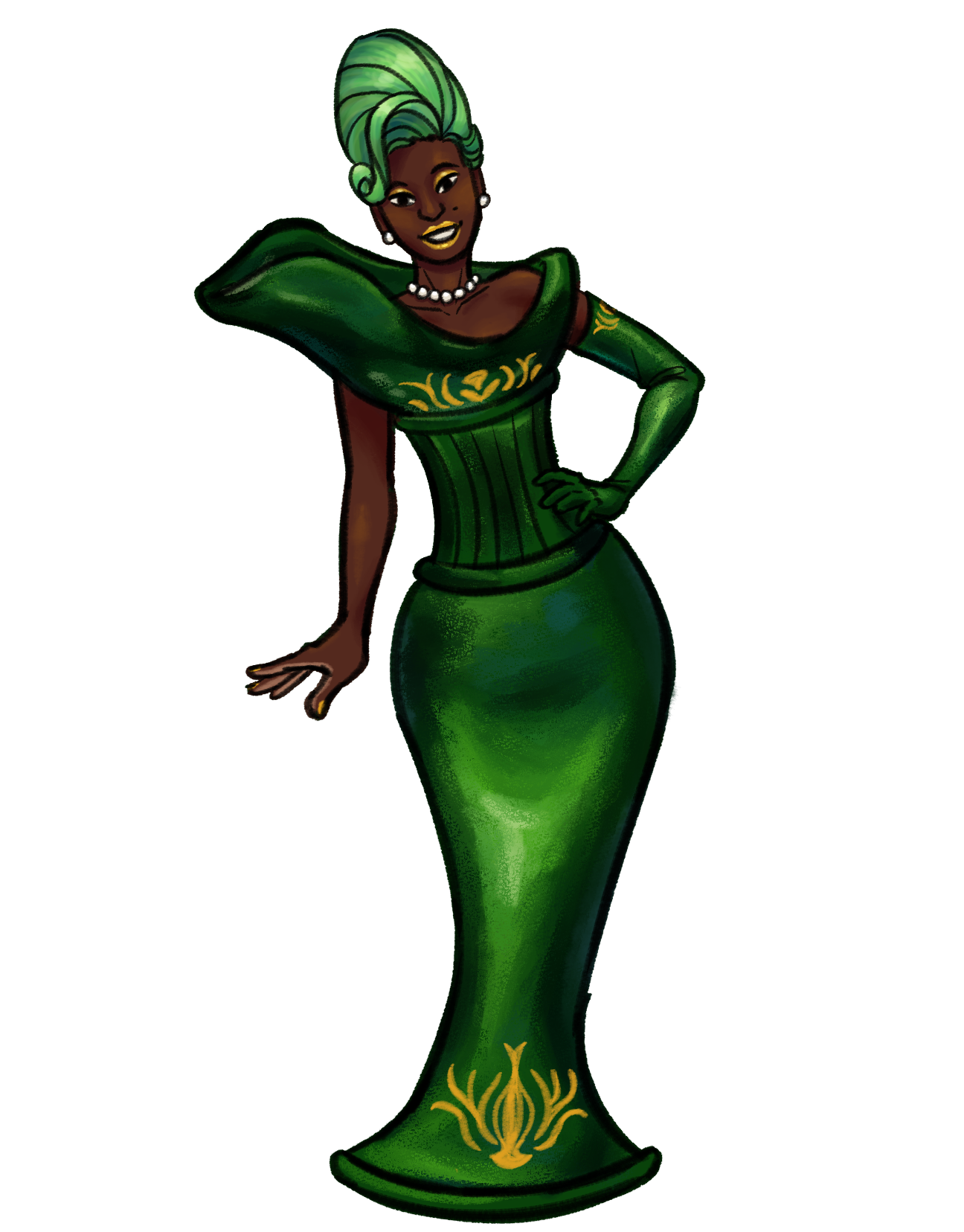
We were instructed to prioritize design over realistic construction. Nevertheless, I imagined that if I were to attempt to make this dress, I would use wiring and a hoop skirt to create the cartoony structure, and layers of green organza to evoke the feeling of glass.
Superhero Design Rendering
Our second task was to create a superhero. This design was meant to focus on how appearance can help communicate a character’s (and/or show’s) given circumstances. I was taking an astronomy course at the time, and it inspired me to make Event Horizon.
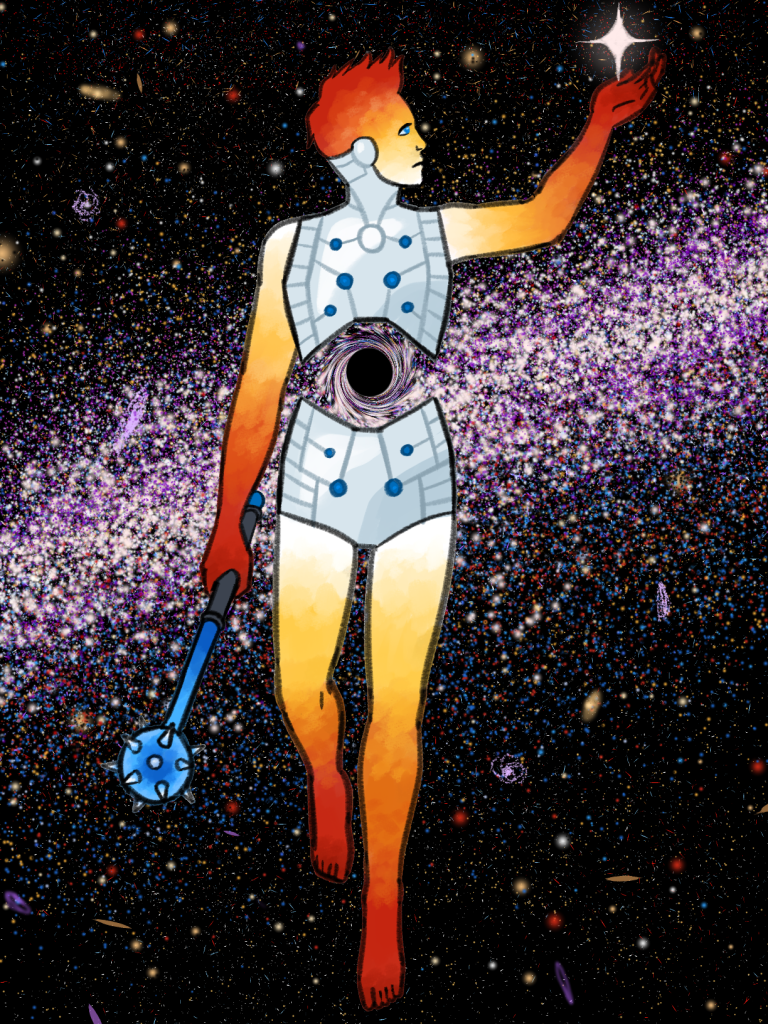
Half human, half unfeeling cosmic energy, she’s an astronaut that fused with a black hole when her ship fell into it. This project was also an entirely theoretical exercise, so I just had fun and ignored all laws of physics.
Final Project – Puppet Construction
Our final in this course was to design a costume for a character from a theatrical work, and then construct a puppet and puppet-sized costume based on that design.
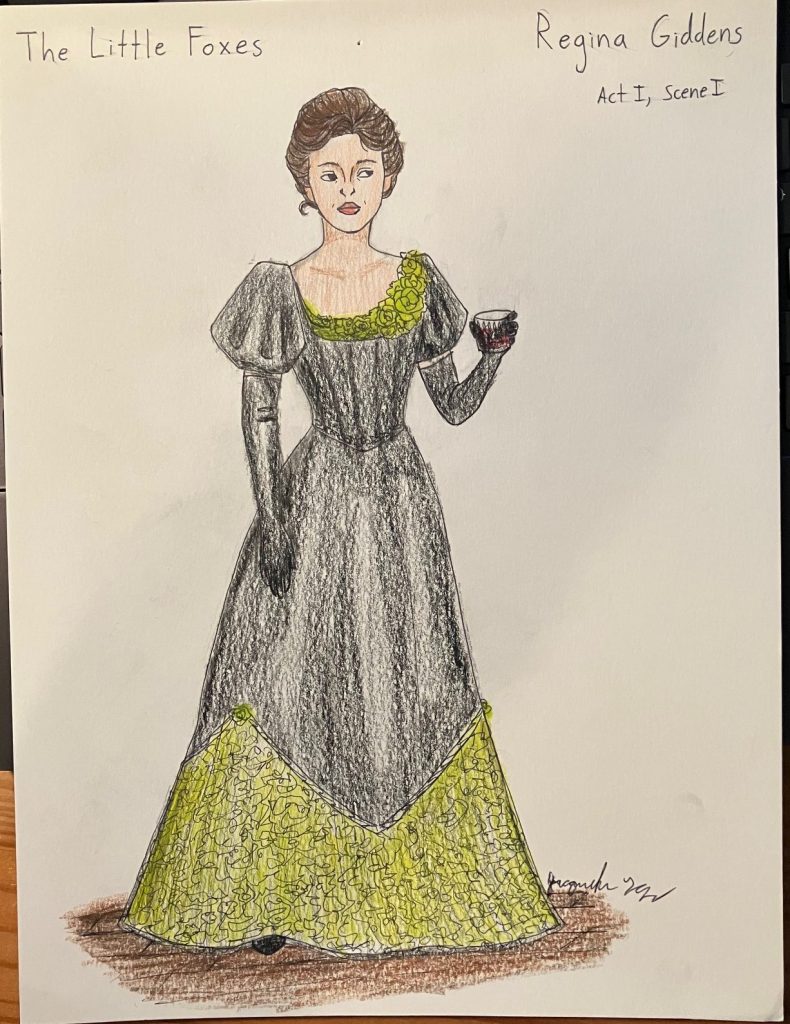
I chose the character Regina Giddens from the play The Little Foxes by Lillian Hellman. My design was inspired by fashion catalogues from the 1890s and 1900s, gowns designed by French designer Charles Frederick Worth, Bette Davis in the 1941 film adaptation (costumes designed by Orry-Kelly), and illustrations by Charles Dana Gibson.
Regina is a intelligent and confident character, but she is consumed by a desire for wealth and social status. While she admires the newest fashions from Europe, she does not have the means to purchase them.
The play is set in 1900. I intended for this design to appear as if Regina had taken an older gown and had it altered to be more in line with turn of the century fashion. Structure and silhouette are not so easily altered, and 1890s aesthetics remain in the leg-of-mutton sleeves and the shape of the skirt.
We started with the puppet. Pattern pieces were traced on skin-toned cotton, cut, and sewed on a machine. One of the most challenging parts of this project was turning the very small limbs inside out so they could be stuffed.
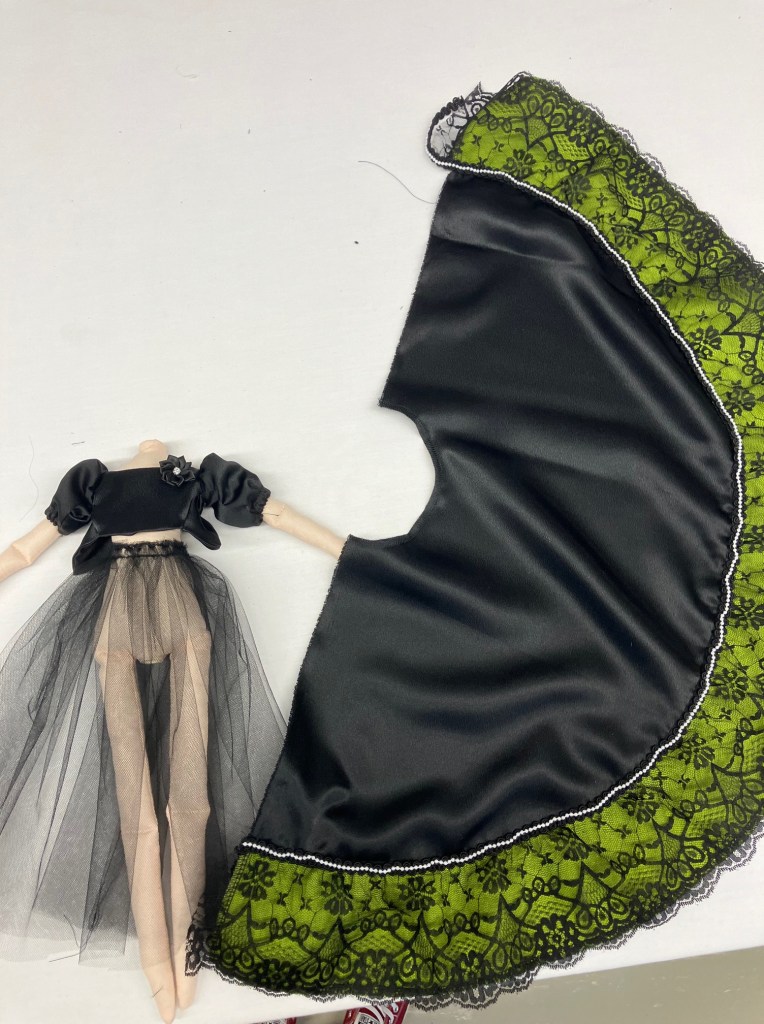
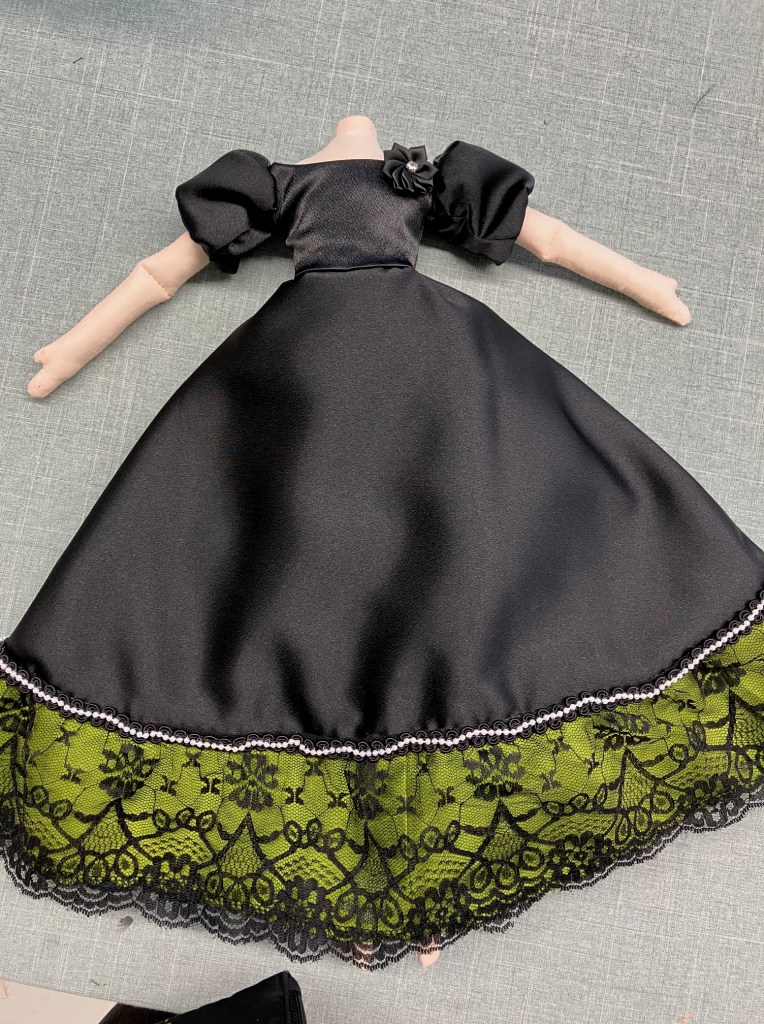
Once the body was completed, we moved on to the costume, once again following a pattern. Her petticoat is a mesh fabric gathered at the waist to give the skirt a little more fullness. Her skirt is a half circle of black satin, with green fabric at the bottom underneath a layer of black lace trim.
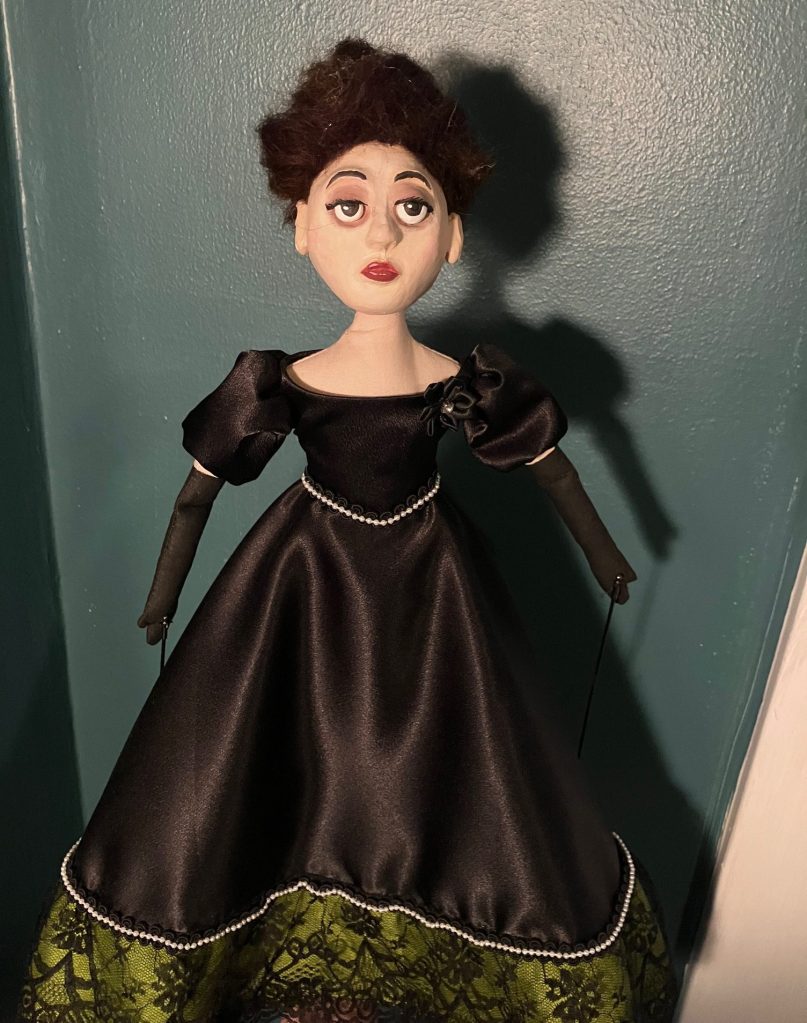
We were working with leftover fabric so our options were limited, and everything had to be doll-sized, so certain details were omitted for the sake of practicality.
Her head was sculpted with polymer clay, and painted with acrylics once it dried. The hair was created using wool fibers and hot glue. Her gloves were painted directly on the fabric of her arms.
Lastly, I attached umbrella spokes to her hands for articulation, and she was completed.
